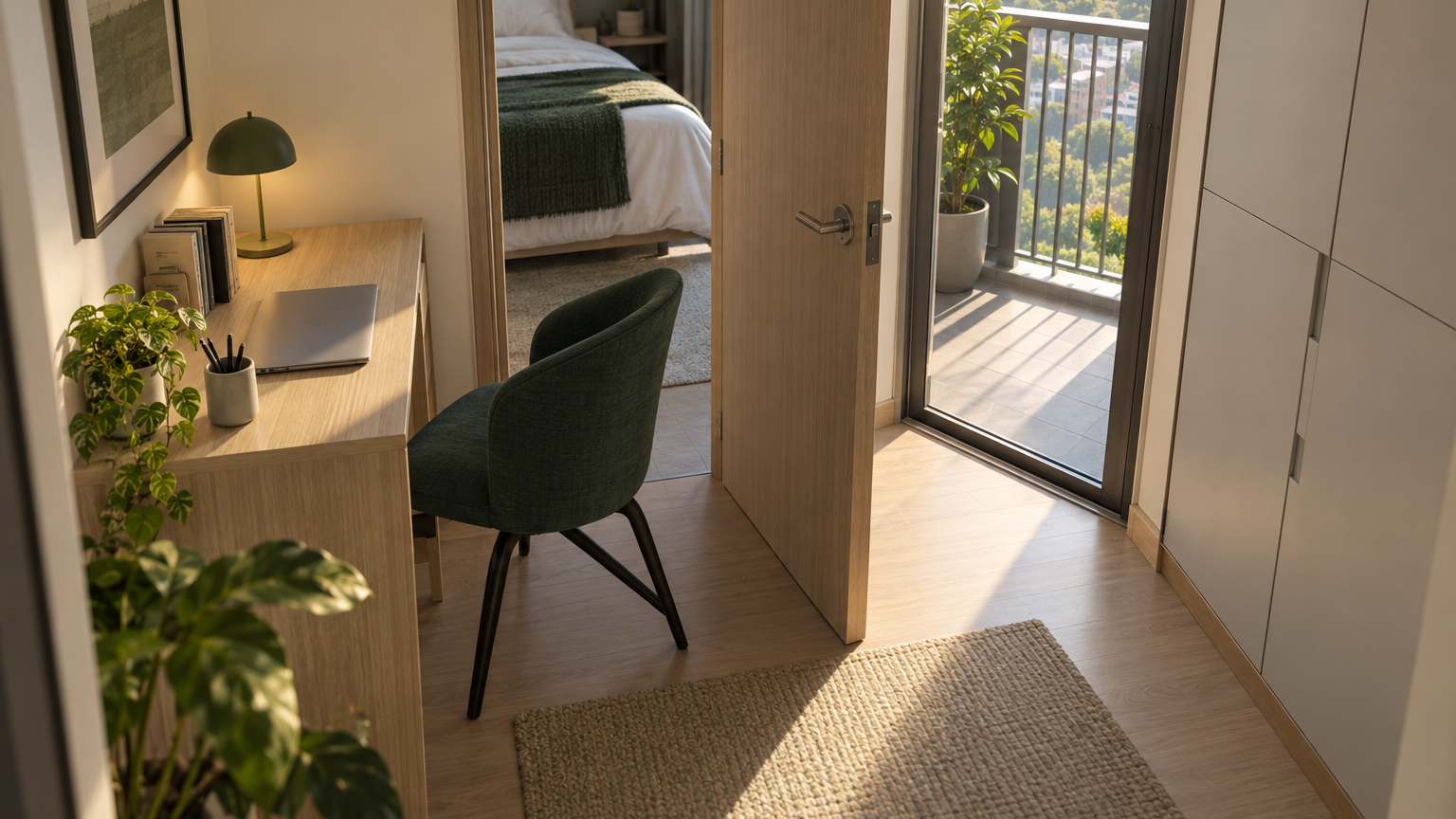
With S$1.4 million as your search budget, would you choose a one-bedroom home with a comfortable work corner, or accept a tighter living room to keep the purchase price down? That is the useful compact-home question—not which development has the most attractive headline price.
This is a budget exercise, not a claim that a particular apartment is available for S$1.4 million. For a solo buyer, the comparison needs to connect four things: the specific home you can buy, the space you can use, its recurring costs and the alternatives available when you eventually sell.
Start with an apartment, not a land price
The authoritative records for two locations in the earlier comparison describe land purchases. The 2025 Dairy Farm Walk tender record gives a successful bid of S$504.515 million, while the separate Lentor Gardens record gives S$429.23 million. Both sites were offered on 99-year leases. Those figures belong to development sites, not individual apartments.
A land award is therefore the wrong starting point for deciding whether your budget buys a practical one-bedder. Dividing the bid by an assumed number of homes would still leave you without the price, size or layout of the apartment you might purchase.
URA’s Developers’ Sales service is more relevant for checking monthly project-level launches, sales and unsold stock. Its figures come from licensed developers, and sales are based on Options to Purchase issued. But a project-level stock figure is not a current availability schedule for a particular bedroom type.
The material gap in this comparison is straightforward: the available authoritative evidence does not establish current, comparable one-bedroom prices, availability and measured layouts across Vela Bay, Narra Residences and Lentor Gardens Residences. There is no sound basis here for ranking their cheapest bookable compact homes.
For your own shortlist, attach each price to a dated written quote and a specific unit. Record its floor, bedroom description, stated area, tenure and expected handover date. Keep completed purchases separate from asking prices. A price becomes useful when you know exactly which home it describes.
Give balcony, storage and walking space different jobs
For this guide, assess a compact home in four parts: enclosed everyday space; storage and utility space; outdoor space; and circulation—the room needed to move around and open doors. This is an editorial usability exercise, not a certified calculation of internal floor area.
Start with the activities that matter to you. If you work from home three days a week, draw your actual desk and chair into the plan. Check the chair when pulled back, not neatly tucked away. Then trace the route from the bedroom to the bathroom and from the kitchen to the dining seat.
Treat a balcony separately from enclosed living space. Ask whether you would genuinely use it for meals, plants or drying clothes, and whether the indoor room still works with the balcony door accessible. Do not count the same patch of floor as both a dining area and a clear walking route.
Storage deserves its own inspection. Mark where the suitcase, vacuum cleaner, laundry basket and cleaning supplies would go. A home that looks spacious without those objects may feel different once you move in.
Finally, check the bedroom with the bed size you intend to use. Can you reach the wardrobe, change the sheets and open the door comfortably? A “study” label or an additional room should earn its place through a task you can actually perform there—not simply through its name.
Compare the purchase commitment, not just the headline budget
Keep three columns in your buying worksheet: apartment price, other upfront costs and recurring ownership costs. This avoids treating the entire S$1.4 million search budget as though it were automatically available for the purchase price alone.
Ask for written estimates relevant to your circumstances for legal work, applicable taxes, financing, furnishing and any renovation. This guide does not calculate stamp duty or borrowing eligibility: those require a separate check against the applicable official rules and your own position.
For a comparison method, imagine two entirely hypothetical homes priced at S$1.35 million and S$1.4 million. The S$50,000 difference is an illustrative purchase-price gap, not evidence that the cheaper home is better value. Put beside it the specific benefit of the dearer option: perhaps a workable desk position, better storage or a bedroom you can move around in.
Then ask whether you would choose to spend S$50,000 for that benefit. This is more revealing than assuming every extra square foot is equally useful. If neither layout fits your everyday furniture, widening the search may be more sensible than stretching the budget.
Turn a rental headline into a cash worksheet
For a rental estimate, begin with achieved contracts rather than an advertised yield. URA provides private-residential rental-contract information through its property-data services. Use the closest available matches for project, bedroom count, floor-area band and contract period, and record where the matches are imperfect.
If there are too few comparable records, leave the rent estimate provisional. A whole-condominium average should not stand in for evidence about a particular one-bedroom home.
Here is a purely illustrative calculation, unrelated to any named project. Assume a S$1.4 million purchase and monthly rent of S$4,000. Twelve fully paid months produce S$48,000, giving a gross yield of approximately 3.43% before costs: S$48,000 divided by S$1.4 million.
Now assume one vacant month and S$8,000 in annual operating expenses. Rent collected falls to S$44,000; after those assumed expenses, income is S$36,000. That equals approximately 2.57% of the purchase price before mortgage costs and acquisition expenses.
The S$8,000 is an invented worksheet input, not a market benchmark. Replace it with estimates for maintenance, property tax, insurance, letting fees, repairs and replacement items. If you start with rent actually collected, do not subtract vacancy again.
Keep mortgage payments on a separate cash-flow line. The purpose is to see both the property’s operating income and what remains after financing—not to present an advertised gross yield as spendable income.
Put a resale home beside the new-launch option
A resale alternative belongs in the same search, but it needs the same unit-level discipline. URA’s transaction search distinguishes developer sales, based on Options to Purchase, from resale and subsale records drawn from caveats; some transactions may not have caveats lodged.
Select comparable completed-sale records where possible, then inspect the actual resale home. Record remaining tenure, condition, likely works, recurring charges and the layout’s usefulness. Keep any asking-price comparison clearly labelled as an asking price rather than an achieved sale.
Compare what the alternatives let you do. Could an existing one-bedder accommodate your desk without using the dining table? Would another room solve a real household need? Put any additional purchase cost and estimated works beside that benefit rather than assuming either newness or extra bedrooms automatically wins.
Use the same approach when thinking about your eventual buyer. Describe who could use the apartment comfortably and why. That is a practical assessment of flexibility, not a forecast of resale demand or profit.
Decide which compromise you can live with
A useful shortlist should let you explain each home in one sentence: “This costs less but needs a dining-table workspace,” or “This costs more but keeps work out of the bedroom.” Those descriptions expose the choice that a price-per-square-foot comparison can miss.
The conclusion changes if the quoted unit disappears, the plan fails your furniture test, matched rental evidence comes in lower, or ownership costs exceed your allowance. Keep those inputs visible rather than hiding them inside a single score.
Before comparing launch prices again, build a one-page unit audit: dated unit price, usable-space sketch, recurring-cost estimate and matched rental and resale records. The objective is not to find the smallest number on a sales headline. It is to identify a home you can afford to buy, comfortably use and realistically carry.