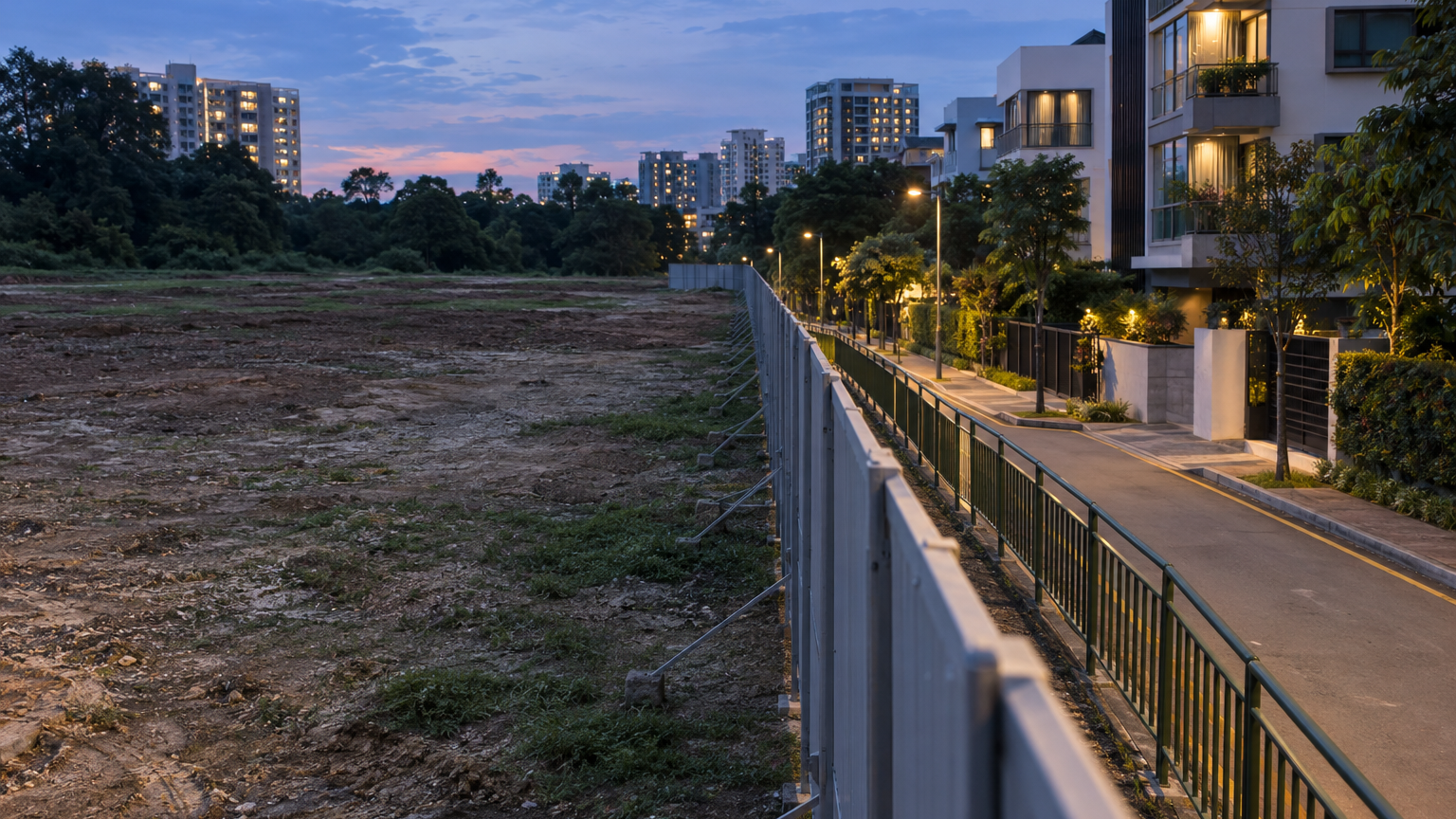
A government land parcel beside Springleaf MRT went from zero bids to five between two tenders. The decisive change: the Urban Redevelopment Authority (URA) removed a requirement to include long-stay serviced apartments before offering the Upper Thomson Road site again.[S1][S2]
URA awarded the relaunched parcel on 31 October 2025 to Wee Hur Property and GSC Holdings for S$613.939 million. The reversal matters to one-bedroom buyers because it exposes a basic category difference: developers were evaluating an entire project, whereas an individual buyer needs to know whether one compact home works financially and practically.[S3]
What changed at Upper Thomson
The original tender for Upper Thomson Road (Parcel A) required at least 4,700 sq m of gross floor area for Serviced Apartments II, or SA2. URA estimated that this portion could accommodate roughly 100 to 145 long-stay apartments alongside conventional homes. The tender closed without a bid on 19 June 2024.[S1][S4]
SA2 was introduced in December 2023 as a distinct form of rental accommodation. Each apartment must be rented for at least three months, while the development cannot be divided into individual legal titles for sale. URA also expects one owner to hold the apartments together and one operator to manage them.[S5]
That meant the first Upper Thomson tender was not simply for a normal condominium beside an MRT station. A developer also had to build and retain a rental component whose apartments could not be sold individually to recover capital.
Following market feedback, URA announced in December 2024 that SA2 would no longer be compulsory at this parcel. The site returned to tender in June 2025 as a conventional residential development with commercial space on the first storey. Five bids followed, with the winning offer working out to S$11,426.59 per sq m of gross floor area.[S2][S3]
The before-and-after result makes the compulsory rental obligation an important difference. It cannot isolate the exact dollar effect, because the tenders also occurred at different times, but it corrects the outdated idea that developers simply rejected Upper Thomson as a location.
Zion and Media Circle produced different outcomes
Zion Road (Parcel A) was the other original mixed-development pilot with compulsory SA2 space. URA awarded it in April 2024 for S$1.106888 billion, with at least 20,000 sq m of gross floor area reserved for long-stay serviced apartments.[S6]
City Developments Limited later said the resulting integrated project, Zyon Grand, would include a 36-storey long-stay serviced-apartment tower containing more than 350 apartments. These remain part of a professionally operated rental building rather than individual homes offered to small landlords.[S7]
Media Circle followed a third model: the whole residential component was intended for SA2 use. Its tender received one bid of S$120.088888 million, but URA declined to award the site in October 2024 because it assessed that offer as too low.[S8]
URA retained the SA2 requirement at Media Circle when it removed Upper Thomson’s mandate. Media Circle subsequently appeared among the sites available for developer application, rather than as a parcel automatically scheduled for tender.[S2][S9]
These three sites were therefore not a neat experiment where location was the only variable. Their scale, tenure, tender timing and compulsory uses differed. Zion is the awarded compulsory-SA2 example; Upper Thomson secured five bids only after its mandate disappeared; Media Circle did not secure an acceptable bid as an SA2-only site.
Why an SA2 apartment is not an investible one-bedder
A tenant may compare an SA2 apartment with a furnished one-bedroom condo when choosing somewhere to live. The ownership proposition is entirely different.
A private condo buyer purchases one legal unit. That unit can provide an owner-occupation, rental or eventual resale route, subject to the relevant rules and tenancy. A retail buyer cannot select one apartment from an SA2 building and buy it as a standalone investment because the apartments must remain under common ownership.[S5]
The land bids therefore reveal how developers valued complete projects under particular conditions. They do not supply the purchase price, achievable rent, maintenance charge, vacancy or resale demand for an individual one-bedroom condo.
There is a conventional condo market in the wider Springleaf area: GuocoLand marketed Springleaf Residence as the first high-rise condominium in its new enclave, with launch pricing advertised from S$1,995 per sq ft. That is useful evidence of how a developer positioned a separate project, but it is not a completed-sale average or a one-bedroom net-yield figure.[S10]
For a compact-home buyer, the relevant entry quantum is the unit’s total purchase price—not merely its price per square foot and certainly not the winning bid for an entire development site. Two units at a similar rate can require very different budgets if their floor areas differ.
Test the space, costs and exit separately
Start with the floor plan. A balcony may be enjoyable, but it is not enclosed, air-conditioned living space. Long entrance passages and awkward routes around furniture can also absorb saleable area without giving you another useful zone.
For two homes of a similar stated size, compare the usable wall length, storage, dining space and clear walking routes. Check whether the bedroom accommodates more than the bed, whether doors collide when opened and how much of the total area sits outdoors. This is more revealing than assuming every square foot performs equally.
Next, separate advertised gross yield from net income. Gross yield generally compares annual rent with purchase price. A more realistic owner’s calculation deducts vacancy, maintenance charges, property tax, agent fees, repairs, furnishing and financing costs where applicable.
Those figures depend on the actual unit and owner. Without verified rent, purchase price and recurring expenses, a polished yield percentage remains an advertisement or estimate—not evidence of what reaches the landlord’s pocket.
Finally, consider the exit. A private one-bedder might later appeal to another investor, a solo owner-occupier or a couple, depending on its price and layout. An SA2 operator has a different problem: it must run rental inventory collectively and cannot sell the apartments one by one.[S5]
The Upper Thomson reversal is best read as a lesson in comparing like with like. A five-bid land tender can show that developers accepted the revised site conditions; it cannot replace the one-bedroom buyer’s work of measuring enclosed usable space, total ownership cost and realistic resale alternatives.
Sources
- CDL posts revenue of S$1.7 billion and PATMI of S$91.2 million for 1H 2025 · City Developments Limited
- Springleaf Residence launch announcement · GuocoLand
- Award of tender for Upper Thomson Road (Parcel A) · Urban Redevelopment Authority
- Award of tender for Zion Road (Parcel A) · Urban Redevelopment Authority
- Government Land Sales Programme for first half of 2025 · Urban Redevelopment Authority
- Guidelines for Serviced Apartments II · Urban Redevelopment Authority
- Media Circle tender not awarded · Urban Redevelopment Authority
- Sites available for application · Urban Redevelopment Authority
- Tender closing for sale site at Upper Thomson Road (Parcel A) · Urban Redevelopment Authority
- Upper Thomson Road (Parcel A) tender details · Urban Redevelopment Authority